Robots.txt Explained: How to Control Search Engine Crawling

    Master crawl budget management and search engine spider directives. Implement precise User-agent, Disallow, Allow, and Sitemap directives to protect server resources and optimize web indexing pathways.

    The Robots Exclusion Protocol: Managing Crawl Traffic for Modern Web Platforms

    For enterprise Webmasters, technical SEO architects, and digital engineering leaders, governing how search engine web crawlers interact with web applications is foundational to search infrastructure stability. A site's robots.txt file serves as the first line of communication between your web server and automated user agents. Rather than allowing search bots to blindly request every accessible URL, a structured Robots Exclusion Standard file directs crawlers toward high-value content while preventing inefficient server resource utilization. At TY ALPHA, TECHNOLOGY, we engineering technical crawling strategies that optimize crawl allocation, reduce server load, and protect sensitive architectural staging environments.

    While search engine spiders systematically discover and analyze web content, managing crawler access relies on five core technical pillars: User-Agent Scope Specification, Disallow & Allow Directive Logic, Crawl Budget Optimization, XML Sitemap Discovery Pathways, and Indexing vs. Crawling Separation. Rather than leaving web indexing to chance, enterprise growth strategy demands a precisely configured robots file where administrative backends, search parameter URLs, and private script directories are protected from unnecessary bot processing.

    Implementing a clean, validated robots.txt file ensures that search engines prioritize your primary landing pages, preserve server bandwidth, and index your digital infrastructure without encountering technical bottlenecks.

    If you need expert engineering assistance auditing your technical SEO setup, configuring crawl parameters, or optimizing enterprise site architecture, our team is ready to assist. Click the link at the bottom of the page to connect with our search infrastructure specialists.

    Robots.txt Architecture and Crawl Budget Optimization Blueprint by TY ALPHA TECHNOLOGY

    The Core Pillars of Effective Robots.txt Configuration

    To ensure your robots.txt file properly guides search engine spiders and preserves technical performance, focus on these foundational directives:

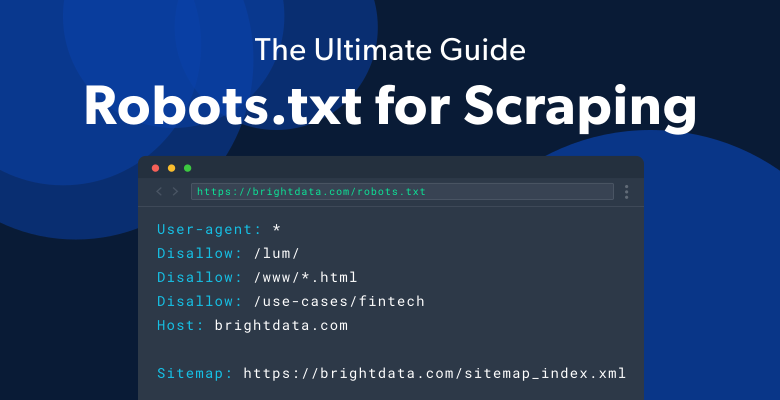
    • User-Agent Targeting: Declaring specific rules for individual search crawlers (e.g., Googlebot, Bingbot, YandexBot) or applying global directives to all spiders using wildcards to control site access per agent type.
    • Disallow Path Restrictions: Blocking search engine access to specific directories, internal site search results, cart checkout paths, and backend administrative panels to prevent thin content crawling.
    • Allow Directive Hierarchy: Creating explicit exceptions within disallowed directories, enabling search engines to access critical assets (such as CSS, JavaScript, or sub-folders) required to render pages accurately.
    • Sitemap Location Declarations: Providing explicit absolute URLs to your primary XML sitemaps directly within the robots file to streamline discovery for search engine indexing engines.
    • Crawl Budget Conservation: Preventing search engine spiders from getting trapped in infinite URL loops, query parameter variations, or redundant staging paths on large-scale web applications.

    The Architectural Advantage: Strategic Crawl Governance

    The primary technical benefit of mastering your site's robots.txt configuration is building a digital ecosystem engineered for fast, efficient server responses and focused content indexing. When search engine bots enter your web server, having clear path boundaries prevents them from wasting processing cycles on non-public assets or duplicate internal URLs.

    By establishing structured crawl boundaries across your domain, search engines dedicate their crawling capacity entirely to your highest-converting pages and primary content hubs. Your new updates index faster, server response times remain steady under high crawler volume, and search engines establish a cleaner understanding of your site hierarchy. At TY ALPHA, TECHNOLOGY, we assist web engineering teams in deploying robust, error-free robots.txt files designed for enterprise-grade performance.


    The Robots.txt Directive Matrix: Syntax, Scope, and Technical Impact

    This structured matrix compares primary robots.txt directives, their technical syntax, and their operational impact on search engine behavior:

    Directive / Command Syntax Example & Scope Impact on Crawling & Server Behavior
    User-agent User-agent: Googlebot
    Target specific or all (*) web crawlers.
    Access Scope. Defines which crawler rules apply to specific search engine bots visiting your web application.
    Disallow Disallow: /admin/
    Blocks path access relative to site root.
    Crawl Prevention. Instructs search bots not to fetch matching URLs, saving server resources and crawl allocation.
    Allow Allow: /admin/public.css
    Overrides parent disallow rules.
    Targeted Asset Rendering. Grants crawlers access to necessary assets inside otherwise restricted directories.
    Sitemap Sitemap: https://domain.com/sitemap.xml
    Absolute URL declaration.
    Accelerated Discovery. Provides search engines direct pathing to your sitemap architecture upon initial connection.

    Technical Realities: Crawling vs. Indexing and Security Considerations

    A common misunderstanding in web development is confusing crawl blocking with index prevention. Disallowing a URL in robots.txt stops search engine bots from fetching the page contents, but if external or internal backlinking exists, search engines may still index the URL title and path without visiting the page.

    To completely exclude sensitive pages from search engine results pages, developer teams should utilize noindex meta directives or HTTP response headers rather than relying solely on disallow rules. Additionally, because robots.txt is a publicly viewable plain-text file, it should never be used as a security mechanism to hide confidential data or secure backend login routes.


    Configuring and Validating Robots.txt: A 6-Step Engineering Roadmap

    To systematically design, test, and deploy a secure and optimized robots.txt file for your platform, follow this six-step implementation guide:

    1. Audit Current Web Architecture and URL Structures

    Identify public content paths, private admin areas, internal search queries, and dynamic staging links across your application.

    2. Define Crawler Boundaries and User-Agent Scope

    Determine which search crawlers require full access and which aggressive non-essential bots should be restricted or blocked.

    3. Draft Precision Disallow and Allow Path Rules

    Write explicit directory paths using standard protocol syntax, ensuring critical CSS, JavaScript, and public resources remain open.

    4. Append XML Sitemap Locations

    Insert absolute HTTPS links to your main sitemap index files at the top or bottom of the robots.txt file for instant spider discovery.

    5. Test Syntax with Google Search Console & Validation Tools

    Run your directives through URL inspection tools and robots validators to ensure no high-value landing pages are blocked accidentally.

    6. Deploy to Root Directory and Monitor Crawl Logs

    Upload the file to https://yourdomain.com/robots.txt and analyze server access logs regularly to verify intended bot behavior.


    Ready to Optimize Your Site's Crawl Budget and Technical SEO?

    Establishing clean crawl control rules is essential for protecting server resources, maximizing search indexing efficiency, and elevating your site's overall search authority.

    If your organization needs expert guidance auditing robots.txt files, optimizing enterprise crawl budgets, or re-engineering technical site architecture, we are ready to assist. The engineering team at TY ALPHA, TECHNOLOGY specializes in keeping complex web platforms scalable, secure, and fully optimized for top search performance.