How to Link Multi-Currency Tools
Show relative local prices based on automatic geographical visitor IP detection to eliminate checkout friction and boost global conversions.
Read Strategy
A simplified explanation of separate frontend interfaces and backend cloud databases.
For over a decade, traditional e-commerce platforms operated on an all-in-one, "monolithic" architecture. In these classic systems, the front-end user interface (everything the shopper sees, clicks, and interacts with) is permanently tied to the back-end database (the engine managing inventory, payment processing, and checkout logic). While simple to launch initially, this tight pairing becomes a technical bottleneck as an online brand scales, trapping merchants within rigid design templates and restricting cross-device adaptation.
Headless e-commerce architecture fundamentally re-engineers this relationship by cleanly separating the presentation layer from the core commerce engine. By removing the "head" (the front-end interface) from the body (the back-end cloud databases), businesses unlock total creative control. Data flows seamlessly between these separate systems via secure Application Programming Interfaces (APIs). This enables a brand to build ultra-custom, high-converting customer experiences across websites, mobile apps, and smart devices without ever disrupting their stable backend operational systems.
At TY ALPHA, TECHNOLOGY, we recognize that navigating modern web infrastructure paradigms can feel overwhelming. We have broken down the mechanics of decoupled systems to help you understand how a headless transition can future-proof your digital enterprise and elevate your customer experience.
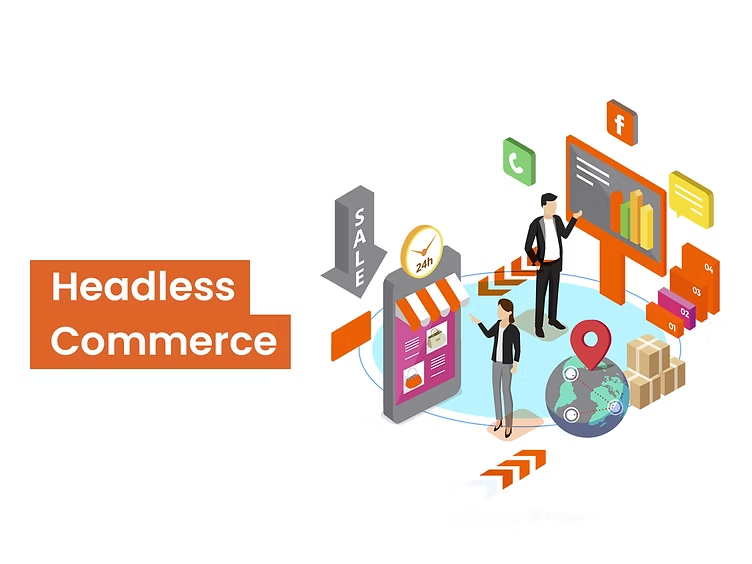
To understand how a headless digital ecosystem functions, it helps to examine its three fundamental, independent layers:
A retail enterprise utilizing a headless configuration functions as a **highly adaptable, omni-channel powerhouse**. In a modern marketplace where consumers buy products through web browsers, social media feeds, smart watches, and interactive retail kiosks, a traditional monolithic platform struggles to keep up. Updating a single front-end element in a monolith requires deploying code across the entire system, creating high maintenance overhead and risking backend system downtime.
By decoupling your systems, you eliminate structural dependencies. Your marketing team can safely redesign your website's main landing page or deploy a specialized mobile app layout without touching a single line of backend checkout code. This allows for lightning-fast site iterations, frictionless multi-regional expansions, and a completely unified customer shopping experience.
At TY ALPHA, TECHNOLOGY, we take the guesswork out of next-generation web engineering. We help brands architect clean headless blueprints, configure secure API pathways, and deploy fast frontend frameworks that seamlessly scale alongside your evolving business logic.
Migrating to a decoupled infrastructure solves many of the performance and design limitations inherent in traditional online store configurations:
| Operational Dimension | Traditional Monolithic Setup | Modern Headless Architecture |
|---|---|---|
| Page Loading & Site Speed | Slower; tied down by rigid database structures, bulky plugins, and heavy backend tracking themes. | Ultra-fast; static frontends serve pre-rendered HTML via global CDNs, bypassing direct database wait times. |
| Design & Layout Freedom | Restricted; developers must work within platform-specific template systems and themes. | Infinite; front-end developers can design any visual layout imaginable using raw Javascript and CSS. |
| Omnichannel Distribution | Difficult; requires building complex duct-tape extensions to push store data to non-web platforms. | Native; a single backend database can push product inventory to any API-connected display or digital device. |
| System Upgrades & Safety | Risky; updating front-end design elements can accidentally break core database or checkout functionality. | Highly Secure; front-end and back-end updates are isolated, meaning design changes never compromise payment safety. |
| Developer Flexibility | Limited; developers must specialize in proprietary template systems (like Shopify Liquid or WordPress PHP). | Broad; team can utilize industry-standard tools (like React or Next.js) to build fast user interfaces. |
One of the single greatest business arguments for making a headless transition is the massive acceleration of page loading speeds. In a traditional store, every time a user requests a page, the server has to construct the layout by querying database tables in real time, creating latency. Headless setups eliminate this by pre-rendering your entire store into static HTML files that load instantly. This directly optimizes your Core Web Vitals, elevating your search placement and lowering bounce rates.
However, building a decoupled ecosystem requires careful asset management. If your custom front-end framework is configured poorly or loaded down with unoptimized third-party client-side Javascript scripts, you lose your performance advantage. We prioritize server-side rendering (SSR) and edge-computed API calls to ensure that dynamic catalog data—such as live stock levels or custom cart totals—loads efficiently without slowing down your site.
By combining custom front-end frameworks with lightweight, cloud-based database integrations, we create an ultra-fast shopping ecosystem. This high-performance architecture ensures your brand loads instantly, maximizes conversion rates, and is ready to scale globally.
Continuing to scale a high-volume retail business on a standard monolithic template limits your long-term growth. You remain dependent on a single software vendor's feature updates, layout restrictions, and server capacities. Migrating to a headless framework, while requiring an initial engineering investment, functions as a highly valuable long-term asset. It grants your brand complete digital independence, allowing you to easily plug in or swap out new services over time without rebuilding your store from scratch.
When your fast page speeds, custom front-end layout, and modular cloud databases run in perfect alignment, your store's scaling potential is unlimited. International buyers encounter an instantly responsive, localized storefront, and transactions execute flawlessly. Our structural development philosophy balances clean, decoupled code with professional backend architecture to keep your digital brand light years ahead of the competition.
To systematically separate your presentation layer and migrate your storefront to an ultra-fast headless setup without risking data loss or sales downtime, we follow a precise 6-step roadmap:
We analyze your legacy system's product catalogs, customer profiles, and metadata schemas to structure a clean cloud database migration blueprint.
We select and configure the ideal headless commerce engine to safely manage your secure payment tokens, shipping profiles, and inventory logic.
We construct a lightning-fast, custom frontend layout from scratch using modern frameworks, ensuring perfect pixel alignment and cross-device scaling.
We build secure API endpoints and configure low-latency webhooks to synchronize your catalog data across your frontend and backend environments instantly.
We host your decoupled presentation layer on decentralized global edge networks (like Vercel or Netlify) to achieve sub-second page loading speeds worldwide.
We run rigorous data load and security tests across your checkout webhooks and payment gateways to guarantee a flawless, stable launch.
Transitioning from a basic webpage to a fully optimized, high-converting retail storefront is a major milestone—it is a bold step toward financial independence, brand recognition, and tapping into a global network of digital consumers.
Whether you are building on Shopify, WooCommerce, or developing a fully custom e-commerce system, we are here to support your growth. If you run into any technical layout conflicts, require assistance connecting complex regional payment gateways, or want professional advice on accelerating your store’s loading speeds, we have you covered. The team at TY ALPHA, TECHNOLOGY specializes in keeping digital architecture clear, simple, and perfectly secure, helping global entrepreneurs build robust online ecosystems designed for sustainable international scaling.

Show relative local prices based on automatic geographical visitor IP detection to eliminate checkout friction and boost global conversions.
Read Strategy
Manage your growing consumer relationships and support history records directly from a unified dashboard to scale your operations effortlessly.
Read Strategy