US Business Bank Accounts for Non-Residents: Requirements & Setup Guide
A comprehensive legal, financial, and operational guide to federal compliance, documentation, and remote corporate banking setup for foreign founders.
Read Strategy
A technical and regulatory guide to tax identification numbers, foreign ownership rules, IRS classifications, and US bank account setup.
Expanding an international business into the United States market offers unprecedented access to global capital, tier-1 merchant processors, and stable USD banking. However, foreign entrepreneurs frequently hit a critical regulatory roadblock early in the onboarding process: understanding the complex interplay between different US tax identification numbers.
Financial institutions in the US operate under stringent Federal Reserve regulations, FinCEN rules, and Financial Action Task Force (FATF) standards. When opening a corporate bank account, financial software platforms and traditional banks ask for identifiers like an EIN (Employer Identification Number), SSN (Social Security Number), or ITIN (Individual Taxpayer Identification Number). Knowing which number belongs to the business entity versus the individual—and what non-US residents are legally required to provide—is vital to avoiding account holds and application rejections.
If you are seeking technical expertise to automate cross-border KYC pipelines, integrate banking APIs, or build foreign entity onboarding workflows, our specialized engineering team is ready to assist. Simply click the link at the bottom of the page to connect with our solutions team.
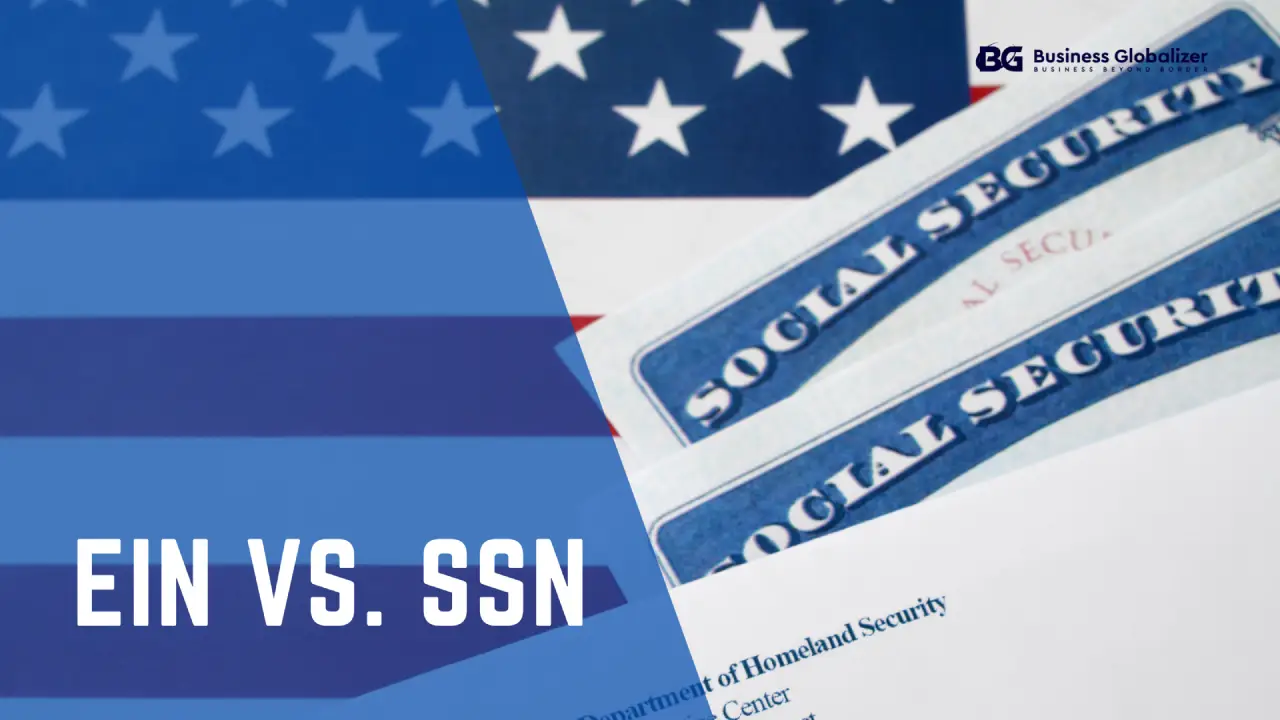
To properly configure your US business banking stack without a US residency footprint, you must distinguish between entity-level and individual-level identifiers:
Because non-resident founders do not possess a Social Security Number, US banks rely on alternative identity verification mechanisms to satisfy CIP (Customer Identification Program) and Beneficial Ownership Information (BOI) rules.
When applying for a business account without an SSN, banks cross-reference your business EIN confirmation letter (Form CP 575 or 147C) alongside high-resolution passport notarizations and utility proof of address. Furthermore, under recent FinCEN regulations, filing your BOI report accurately ensures that the federal government officially recognizes your ultimate beneficial ownership without forcing you to secure a personal US tax ID first.
At TY ALPHA, TECHNOLOGY, we architect secure digital compliance workflows and API data pipelines that streamline identity validation for global enterprises, ensuring long-term operational resilience.
Evaluating the purpose, accessibility, and banking necessity of US tax identification numbers for foreign business owners:
| Identifier Type | EIN (Employer ID Number) | SSN (Social Security Number) | ITIN (Individual Taxpayer ID) |
|---|---|---|---|
| Target Subject | Business Entities (LLC, C-Corp, Partnership) | US Citizens & Authorized Foreign Workers | Non-Resident Foreign Individuals |
| Accessibility for Non-Residents | 100% Accessible (via IRS Form SS-4 filing) | Not Accessible (Requires US residency/visa) | Accessible (via IRS Form W-7 filing) |
| Required for US Business Account? | Yes — Mandatory for all business accounts. | No (Replaced by Passport verification). | No (Optional for business accounts). |
| Issuance Timeline | 4 to 7 business days for foreign owners | N/A for non-residents | 7 to 11 weeks via IRS review |
| Primary Utility | Corporate banking, Stripe, tax filing | Personal credit, US employment, tax ID | Personal US tax filings & personal accounts |
Legacy US brick-and-mortar banks frequently require a physical branch visit or an SSN because their internal software systems were built exclusively for domestic applicants. Trying to apply at traditional banks without an SSN often leads to automated system glitches or prolonged manual reviews.
Modern, digital-first business banking platforms (such as Mercury, Relay Financial, and Brex) are engineered specifically to accommodate non-resident entrepreneurs. These platforms bypass the SSN requirement entirely by utilizing API integrations that validate foreign passports, legal state incorporation certificates, and IRS-verified EIN numbers in real time.
Choosing the right corporate banking technology partner guarantees seamless integration with payment gateways like Stripe and PayPal—enabling rapid global commerce without regional friction.
Understanding that you do not need an SSN or a US physical presence saves foreign entrepreneurs thousands of dollars in unnecessary agency fees, nominee director services, or delayed ITIN processing.
By pairing an IRS-issued EIN with clean corporate incorporation and foreign passport verification, global founders can legally establish a fully compliant US financial hub—enabling global customer billing, USD wire transfers, and seamless merchant payouts from anywhere in the world.
To systematically setup your US corporate structure, secure your EIN without an SSN, and launch an active business bank account, we follow a structured 6-step roadmap:
We register your legal business entity in a business-friendly US jurisdiction (such as Delaware or Wyoming).
We gather and verify the foreign owner's passport credentials and international physical address documentation.
We draft and submit IRS Form SS-4 specifying "Foreign/None" in place of an SSN to secure your corporate tax ID.
We retrieve your official IRS EIN approval paperwork and verify that all business details match state records.
We select an SSN-exempt, non-resident-friendly digital banking platform tailored to your company's business model.
We submit your EIN, passport, state formation documents, and BOI reporting to unlock your active USD banking account.
Securing your business EIN and navigating US banking compliance as a non-resident founder is straightforward when guided by proper legal and technical frameworks.
Whether you are an international SaaS founder, a global e-commerce merchant, or a cross-border agency looking to establish a US banking footprint, we are equipped to support your journey. If you face identity verification blockers, require assistance with foreign EIN filings, or need custom fintech software integration, we have you covered. The engineering team at TY ALPHA, TECHNOLOGY excels at building fast, robust, and compliant technical infrastructure designed for sustainable international expansion.

A comprehensive legal, financial, and operational guide to federal compliance, documentation, and remote corporate banking setup for foreign founders.
Read Strategy
A comprehensive guide to regulatory compliance, verification documents, USD receiving accounts, and payment gateway integration for foreign entrepreneurs.
Read Strategy