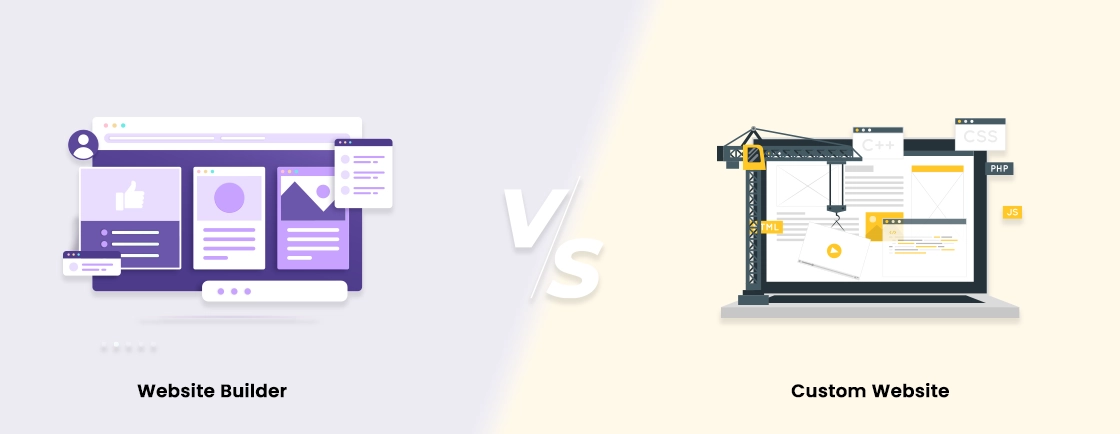
What is the difference between a website built on code and one built on closed platforms?

    Explore the structural, financial, and performance differences between custom code architecture and closed SaaS platforms to secure your digital assets for the long term.

    The Engineering Dilemma: Freedom of Custom Development vs. the Convenience of Leased Ecosystems

    For scaling brands, enterprise directors, and digital-first organizations, evaluating how your website's underlying infrastructure is written is a vital decision that governs your entire technical roadmap. A frequent and costly mistake many expanding businesses make is treating a website purely as a visual layout, ignoring how backend architecture impacts long-term operations. Choosing a website framework often comes down to two opposing development paths: building a platform from scratch using custom code (such as React, Vue, Next.js, or PHP) or leasing an all-in-one space inside a closed SaaS platform (such as Shopify, Squarespace, or Wix). At TY ALPHA, TECHNOLOGY, we believe that understanding the structural reality of these two approaches is essential to maintaining a profitable, unhindered online presence.

    When a business builds on a closed platform, they are essentially renting space inside a proprietary, pre-built ecosystem. The hosting, core security layers, and visual editors are managed entirely by the parent company, which significantly lowers your initial development overhead. However, this convenience comes at the cost of data sovereignty; you cannot access your raw database code, modify underlying server behaviors, or port your software directly to another hosting company if your needs change. Conversely, a custom-coded website grants absolute ownership and code control, allowing your engineering teams to optimize every line of HTML, script file, and server lookup for lightning-fast speeds and specialized database integrations.

    Navigating this technical choice requires looking beyond your immediate launch day and forecasting your three-to-five-year development needs. Learning how closed ecosystems restrict custom integrations and how custom code pathways eliminate recurring monthly platform fees is a natural, routine part of your professional merchant journey. By evaluating these software limitations today, you protect your digital marketing budget and build a web environment optimized for reliable growth.
    Custom Coded Website vs Closed SaaS Platforms Architectural Comparison by TY ALPHA TECHNOLOGY

    The Core Operational Pillars: Structural Differences Explained

    To systematically contrast custom code against fully managed closed environments, you must analyze these five key operational areas:

    • Data Sovereignty and Platform Independence: Custom code gives your corporation absolute ownership of your software files and databases. Closed platforms lease you an interface, meaning your business cannot download or migrate its full technical ecosystem.
    • Code Cleanliness and Page Speed: Custom development injects only the exact scripts required for your layout. Closed builders rely on generic, one-size-fits-all visual block layouts, which often generate unnecessary code bloat that slows down mobile devices.
    • Custom Integration and API Flexibility: Coded frameworks allow you to connect directly with specialized local ERP systems, regional payment gateways, or custom shipping logic without paying third-party app store subscription fees.
    • Security and Patch Management: Closed platforms maintain hands-free security filters and handle server patches automatically. A custom codebase gives you control over your security architecture, but requires proactive manual maintenance.
    • SEO Optimization and Core Web Vitals: Custom environments give your marketing teams direct access to structure data tags, server headers, and clean asset caching, allowing you to hit perfect scores on Google speed diagnostics.

    Why Absolute Code Control Defeats Closed SaaS Platform Restrictions

    When faced with launching a new digital strategy, many operators opt for a closed system because it offers a fast setup and an intuitive interface. While these managed services are excellent for basic portfolios and simple retail stores, growing mid-market enterprises eventually outgrow standard platform limits. As your customer user acquisition pipelines grow more complex, running into rigid template limitations, forced checkout layouts, or transaction fee penalties can stifle your business agility.

    By investing in a custom code solution or open-source infrastructure, you eliminate these artificial development walls. Your team gains the freedom to create tailored checkout flows, run advanced server-level optimization, and protect your digital assets from unexpected platform price drops or terms of service updates. At TY ALPHA, TECHNOLOGY, we partner with growing brands to build clean, flexible web architectures, ensuring your software scales smoothly alongside your traffic.


    The Comparison Matrix: Coded Systems vs. Closed Platforms

    This balanced matrix compares the day-to-day and long-term differences of running a website on custom code versus a closed SaaS ecosystem:

    Technical Performance Metrics Custom-Coded Development Architecture Closed Managed Platforms (SaaS Ecosystems)
    Monthly Software Licensing Costs **Zero subscription fees.** You pay only for your standard server hosting and domain renewal. **Recurring subscription fees.** Monthly costs escalate as you unlock advanced features or add app extensions.
    Fulfillment of Custom Features **Limitless capabilities.** Developers can write bespoke scripts to execute any specialized business workflow. **Restricted capabilities.** You are confined to the features available in their pre-built app store catalog.
    Time to First Byte (TTFB) & Speed **Maximum efficiency.** Clean, optimized scripts deliver instant rendering and superior Core Web Vitals performance. **Moderate efficiency.** Shared database servers and generic theme builders can introduce unavoidable loading lag.
    Migration Freedom & Portability **100% Portable.** Your files and database backups can be deployed instantly to any server provider globally. **Platform Lock-In.** Content can be exported as raw data, but the visual site must be completely rebuilt from scratch.
    Transactional Fee Penalties **Zero fees.** Your brand negotiates directly with your chosen bank or payment gateway processor. **Forced fee penalties.** Platforms often deduct an extra percentage per sale if you use external payment providers.

    Smart Financial Planning: Calculating the True Total Cost of Ownership (TCO)

    A common point of failure for corporate planning is choosing a website setup based entirely on initial launch costs. A closed platform may seem highly cost-effective at first glance due to its low initial setup fees. However, as your business transactions grow, adding mandatory premium extensions for automated shipping, tax compliance, or advanced user forms can cause your monthly operational costs to rise steadily over time.

    Conversely, a custom-coded system requires a higher upfront engineering investment for design, development, and system security testing. However, because you aren't paying a monthly license premium to a third-party service, your ongoing software costs remain flat even as your traffic spikes. Choosing between these models isn't about finding the cheapest option today, but about deciding whether your budget is better spent on predictable SaaS subscription leasing or investing in permanent software infrastructure.


    Strategic Selection Guide: Determining Your Ideal Technical Pathway

    To evaluate your business goals and choose the right structural option without experiencing costly platform adjustments, walk your team through these six steps:

    1. Audit Your Long-Term Technical Goals

    Define the exact core purpose of your platform. If your layout requires unique data models, deep ERP syncing, or specific automated tools, leaning toward custom code is best.

    2. Assess Your Internal Engineering Capabilities

    Review your active development resources. Closed platforms keep operations hands-off for small teams, whereas custom-coded files require ongoing access to technical support.

    3. Calculate Your 3-Year App and Subscription Costs

    Estimate the hidden costs of your platform. Add up baseline plan costs and the recurring fees of the third-party extensions required to handle your operations as you scale.

    4. Measure Your Search Engine and Performance Needs

    Analyze how much your brand relies on fast page speeds and organic search indexing. Custom code lets you optimize scripts perfectly to hit top scores on mobile diagnostics.

    5. Evaluate Your Cross-Border Scaling Strategy

    Review how your system handles multi-currency setups, distinct regional storefronts, and warehouse tracking across international borders without running into system limits.

    6. Establish Data Control and Ownership Policies

    Determine your company's data privacy needs. Decide if you prefer a platform that manages core security automatically, or if you want complete control over your database files and customer logs.


    Need Professional Engineering Support to Design, Code, or Migrate Your Web Architecture?

    Choosing your website's development model is a defining business milestone—it is a direct investment in your user experience, operational safety, and multi-year scalability across digital networks.

    If your fast-growing brand requires an advanced architectural consultation, a secure migration away from a restrictive platform, or a custom-coded system built for high-volume traffic, we are here to support you. The team at TY ALPHA, TECHNOLOGY specializes in keeping complex digital systems clear, fast, and secure, helping corporate leaders run highly responsive web storefronts built for enduring commercial growth.