Why Online Payments Matter More Than Ever in 2026
How businesses are adapting to faster, smarter, and more secure payment technologies.
Read Strategy
Comparing top processing platforms, checkout conversion tools, and multi-channel payment ecosystems for modern merchants.
In 2026, the global e-commerce environment is defined by relentless speed, hyper-localized customer preferences, and sophisticated cross-border shopping behaviors. Choosing the best e-commerce payment platform is no longer a simple technical decision about accepting credit cards—it is the core strategic infrastructure that directly controls your checkout conversion rates, customer acquisition costs (CAC), and overall enterprise profitability.
Modern e-commerce brands cannot afford checkout friction, unoptimized payment pages, or unexpected authorization failures. A customer experiencing even a slight delay or a missing preferred payment method will abandon their cart in seconds. Leading payment platforms have evolved from basic credit card processors into comprehensive fintech ecosystems—offering built-in buy-now-pay-later (BNPL) options, multi-currency wallets, automated tax compliance, and AI-driven fraud prevention out of the box.
At TY ALPHA, TECHNOLOGY, we design, integrate, and optimize high-converting storefront architectures for scaling digital brands worldwide. We have engineered this definitive 2026 platform guide to help you evaluate the top e-commerce payment solutions, understand their technical capabilities, and select the perfect processing engine to power your storefront growth.
If you are seeking guidance on selecting or connecting the best payment platform for your e-commerce store, our specialized engineering team is ready to assist. We specialize in seamless multi-platform API integrations and speed optimization; simply click the link at the bottom of the page to connect with our solutions team.
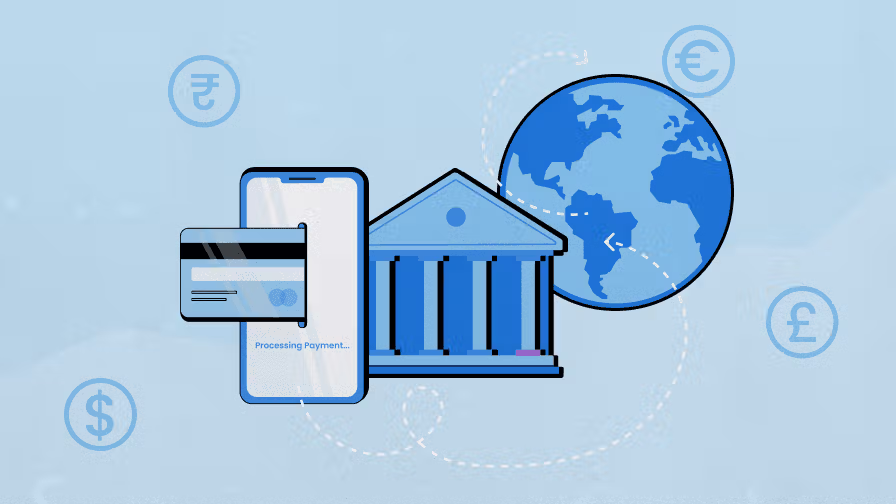
To select the ideal payment platform for your e-commerce model, you must evaluate the three dominant platform architectural models operating in 2026:
Using an outdated or poorly configured e-commerce payment processor directly degrades your bottom line. Basic processing channels often suffer from unnecessary false-positive declines, rigid fraud blocks, and excessive cross-border markup fees that eat into your profit margins.
Upgrading to an optimized 2026 payment platform ensures maximum authorization clearance. By leveraging dynamic 3D Secure 2.3 authentication, AI-driven fraud engines, and network tokenization, top platforms protect your incoming revenue streams while maintaining a frictionless single-tap purchasing experience for valid customers.
At TY ALPHA, TECHNOLOGY, we configure clean, API-driven platform integrations that link seamlessly to your storefront backend, making sure your checkout system processes every transaction quickly, securely, and cost-effectively.
Evaluating the structural, compliance, and fee characteristics across the primary e-commerce payment platform categories in 2026:
| Platform Attribute | Merchant Aggregators (Stripe/PayPal) | Merchant of Record (Paddle/MoR) | Enterprise Processing (Adyen) |
|---|---|---|---|
| Global Tax & VAT Liability | Merchant's responsibility; requires third-party tax software integration. | 100% Platform responsibility; calculates, collects, and remits tax automatically. | Merchant's responsibility; extensive enterprise reporting provided. |
| Pricing Structure | Standard flat-rate fees per successful transaction. | Higher percentage margin; includes global tax management and fraud protection. | |
| Account Setup Velocity | Instantaneous; simple online onboarding for most standard regions. | Fast onboarding; tailored for digital and global product sales. | Custom underwriting; requires thorough enterprise vetting. |
| Cross-Border FX Routing | Standard cross-border surcharges apply unless local accounts are linked. | Seamless; accepts 100+ local currencies with automatic multi-currency payouts. | Direct local acquiring across 50+ countries; lowest foreign conversion fees. |
| Checkout Customization | High; embedded iframe components, hosted elements, and custom styling APIs. | Moderate; hosted checkout pages or overlay pop-up modals. | Absolute control; full headless API integration tailored to your UI/UX. |
Integrating heavy third-party payment scripts, multi-currency conversion modules, and fraud verification webhooks can slow down your checkout page speed if implemented carelessly. In 2026, web performance is directly tied to financial conversion—a lag of even 200 milliseconds during checkout initialization causes sharp spikes in buyer drop-off.
To ensure your checkout experience remains lightning-fast, we focus on asynchronous script loading, lightweight API payloads, and edge-routed webhooks. This technical approach guarantees that payment inputs, localized currency displays, and biometric prompts render instantly without blocking the visual elements of your checkout interface.
Combining an optimized payment platform with a fast, lightweight frontend design gives your business an unbeatable competitive advantage. Keeping your checkout ultra-responsive preserves ad ROI, satisfies search engine algorithms, and provides shoppers with immediate purchasing confidence.
Relying on multi-step checkout forms that require customers to manually type their 16-digit card numbers, expiration dates, and billing addresses is a recipe for high cart abandonment.
Leading 2026 e-commerce payment platforms leverage vault-tokenized, single-click checkout networks (such as Apple Pay, Google Pay, Shop Pay, and Link). When a returning customer lands on your store, their credentials, shipping addresses, and payment tokens are recognized instantly, allowing them to complete the purchase with a single biometric touch. This seamless experience dramatically increases mobile conversion rates and boosts customer lifetime value.
To systematically audit your storefront requirements, select the best payment platform partner, and launch an optimized checkout flow, we execute a structured 6-step roadmap:
We analyze your business model, target geographic markets, sales volume, and tax compliance needs to isolate the best platform tier.
We guide you through selecting and setting up your primary payment platform account (Stripe, Adyen, Paddle, or custom options) to ensure clean approval.
We integrate platform SDKs into your backend (Shopify, WooCommerce, or custom React/Node engines) and configure dynamic multi-currency display.
We enable and style Apple Pay, Google Pay, and single-touch payment triggers directly on product and cart pages for instant checkout.
We configure dynamic 3DS 2.3 verification, AI fraud rules, and network tokenization stores to protect incoming sales capital.
We run latency tests, compress verification script assets, conduct end-to-end trial transactions, and launch your e-commerce payment stack live.
Upgrading to an advanced, high-converting e-commerce payment platform is a pivotal milestone—it lowers processing friction, eliminates global tax headaches, and provides a solid foundation for sustainable international scaling.
Whether you are operating a high-volume D2C brand, a custom-engineered enterprise store, or expanding into multi-regional markets, we are equipped to power your technical success. If you need assistance selecting between processors, integrating single-click checkout engines, or accelerating your store’s loading speeds, we have you covered. The team at TY ALPHA, TECHNOLOGY specializes in keeping digital architecture fast, clear, and completely secure, helping global entrepreneurs build powerful e-commerce ecosystems designed for sustainable growth.

How businesses are adapting to faster, smarter, and more secure payment technologies.
Read Strategy
How modern payment solutions are making global transactions faster, safer, and more accessible.
Read Strategy